Why a Running Order Can Change the Feel of a Show
Plan a running order that helps audiences follow a live show, accounts for practical handovers and gives each performance the conditions it needs to land.
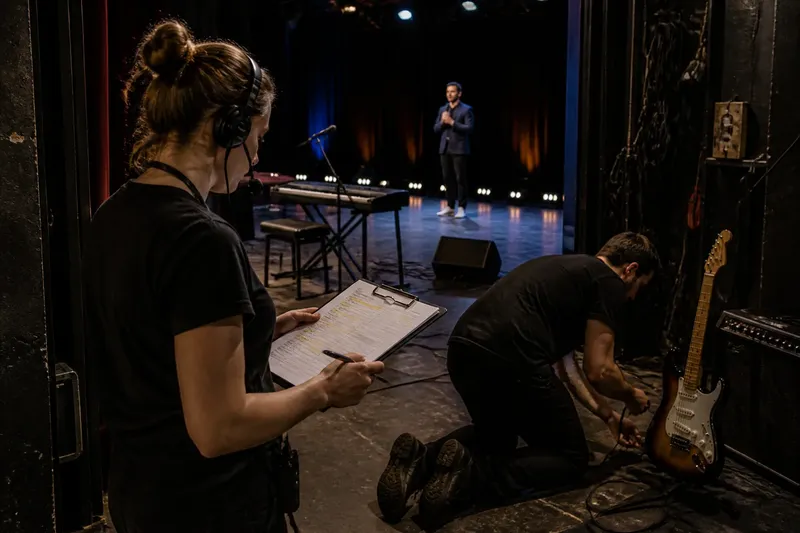
The stage manager checks the next cue while a guitar is still being unplugged; at the back of the room, the host waits for a signal before speaking. A running order for a live show has to account for this work as well as the performances. Its sequence shapes not only what the audience sees, but also how performers, technicians and front-of-house staff move through the event.
That makes the order a production document, not merely a list of acts. It should tell the team what happens, what must be ready beforehand and who confirms the handover. The audience may never see those instructions, but they will notice when a performer is ready to begin without waiting through avoidable confusion.
A running order for a live show needs a production logic
Start with the requirements that can constrain placement: instrument changes, costume adjustments, dance-floor clearance, microphone needs, comedy props, lighting states and access routes. Ask each performer or act representative what must be in place before they enter and what needs to happen after they finish. Keep these notes beside the proposed sequence, rather than relying on memory or a message thread.
Then distinguish fixed conditions from preferences. A drum kit that cannot be moved quickly may affect adjacent concert slots; a dance piece that needs a clear floor may require a planned reset. A preference for a particular position can still matter, but it should be considered alongside what the venue and crew can deliver.
- If an act needs equipment that can remain in place: check which other performers can use the same setup; if there is a compatible act, consider grouping them, and if not, plan a clear changeover.
- If a costume or prop change needs privacy: check the route and changing space; if the transition is workable, assign a named person to manage it, and if not, move the act or alter the staging plan.
- If a performance requires a clear floor: check what must be removed and who will remove it; if the crew can reset safely during the handover, schedule that task, and if not, place the performance where a fuller reset is possible.
- If a performer depends on a specific microphone or monitor arrangement: check the technical notes against the venue plan; if the setup can be recalled, mark the cue, and if not, agree a simpler arrangement with the sound team.
- If an act has a strict entrance or exit route: check that it does not conflict with another performer or audience access; if the route is clear, brief the relevant people, and if not, revise the blocking or slot.
- If the next act cannot begin until a task is complete: check who owns that task and how completion will be signalled; if one person can confirm it, name them in the running order, and if not, simplify the handover.
These checks are more useful than treating every slot as interchangeable. They also make trade-offs visible early: a particular pairing may save a reset, while separating those acts may better serve the programme. The team can then decide knowingly rather than discovering the conflict at the stage door.
Write handovers so the crew can act on them
For each transition, record the action, the person responsible and the cue that shows it is complete. “Change set” is vague; “Stage crew clear two chairs after the host’s introduction, then confirm ready to the stage manager” gives people a task and a point of confirmation. Use names or job roles that match the venue’s actual team.
Keep audience-facing language separate from operational instructions. The host may introduce a performer while the crew resets, but the introduction should not depend on technical work being completed at an uncertain moment. Agree a cue—such as a light change or a stage manager’s signal—so the performer knows when to enter.
It is not worth scripting every breath, applause beat or minor movement. Overly detailed timing can become brittle when a live audience responds differently than expected. Record the decisions that affect readiness, safety, access and the next cue; let routine applause and natural pauses remain flexible.
Build a workable order from the actual requirements
Imagine a community arts night with three acts: a singer who uses a keyboard, a comic performer who needs a handheld microphone, and a dance duo that needs an empty floor. The venue has one keyboard stand and a small crew. The organiser writes down the requirements, checks which equipment can stay onstage, and learns that the dance floor needs to be cleared after the keyboard is removed.
The organiser places the singer before the dance duo, then schedules the keyboard removal as a named crew task. The comic performer sits between them, using the handover to keep the audience engaged while the stage manager confirms the floor is clear. The resulting order is singer, comedy, dance; its practical trade-off is that the comedy slot must allow the reset without making the dancers wait for an unconfirmed cue.
To make that trade-off manageable, the organiser assigns the stage manager to signal readiness and tells the host to use a short, flexible introduction. If the floor is not clear when the introduction ends, the host can pause on the agreed cue rather than sending the dancers into an unfinished space. The running order now contains both the sequence and the decision point.
Check the running order before the room fills
Review the document with the stage manager, sound and lighting operators, front-of-house lead and performers who have special requirements. Check that each handover has an owner, that necessary equipment is accounted for and that the team knows how to communicate a delay. A printed copy at the prompt position can help, while a shared digital version is useful for controlled updates; choose one authoritative version and remove superseded copies.
Run through the order verbally from the opening cue to the final exit. For each slot, ask what must be ready, what happens when the act ends and who gives the next signal. If anyone cannot answer those questions, clarify the document before the audience arrives.
What should a live-show running order answer?
Who should own each changeover?
Name the stage crew member, operator or stage manager responsible for each action, using the role the venue team recognises. If several people need to coordinate, identify who confirms that the stage is ready so the incoming performer is not left to guess.
How should the team handle a delayed cue?
Agree a simple fallback before the show, such as the host extending an introduction or the stage manager holding the next entrance. If the delay affects a safety or access requirement, wait for the responsible person’s confirmation rather than trying to recover time by skipping the check.
What belongs in the audience-facing programme?
Include the act names and any announced break or change that helps the audience follow the event. Keep technical instructions, private access details and crew assignments in the production copy, where the people who need them can use them.
How often should the running order be updated?
Update it whenever a confirmed change affects sequence, equipment, cues or responsibility, then tell everyone who uses the document. If a change is only a tentative idea, mark it clearly as unconfirmed rather than letting it appear as an instruction.
Keep one clear version in circulation
A running order works when the people responsible for the next action can find the same information at the same time. Put the current sequence, handover instructions and cue responsibilities together, and make late changes through one agreed person. That small discipline helps the audience experience a continuous event while the team retains the clarity to respond when the evening does not follow the page exactly.